


October 2005 – February 2006
Here are excerpts from the Minutes of the meetings of the Depleted Uranium Firing Environmental Review Committee which relate to the firings at at the Kirkcudbright Range, near Dundrennan, Dumfries and Galloway.
An introduction to these Minutes is here.
Acronyms:
KTA, Kirkcudbright Training Area, Ministry of Defence (MOD)
DERA, The Defence Evaluation and Research Agency, established in April 1991 as part of the MOD. In July 2001, DERA was split into two organisations:
QinetiQ, a privatised commercial company, and
DSTL, Defence Science and Technology Laboratory (MOD)
RO, Royal Ordnance
BNFL, British Nuclear Fuels Ltd.
EA, Environment Agency
SEPA, Scottish Environment Protection Agency
DTEO, Defence Test and Evaluation Organisation (MOD)
PLSD, Protection and Life Sciences Division (MOD)
CDA, Centre for Defence Analysis (MOD)
D SEF Pol, Directorate of Safety, Environmental and Fire Policy (MOD)
DG(Nuc), Director General (Nuclear) (MOD)
DUWG, Depleted Uranium Working Group (MOD)
Excerpts from Minutes of the 41st Meeting of the Depleted Uranium Firing Environmental Review Committee (DUFERC) on 5 October 2005
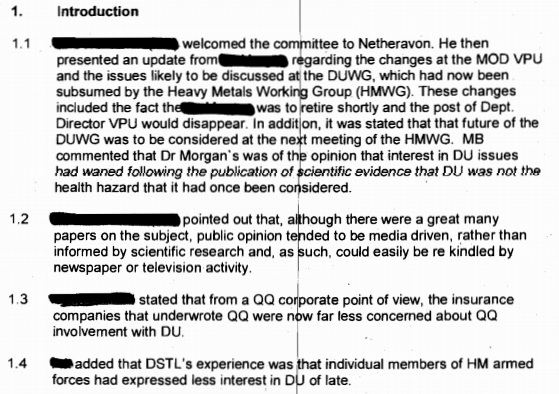
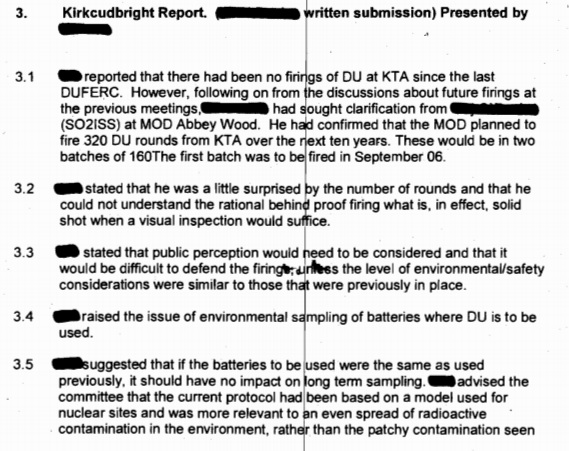
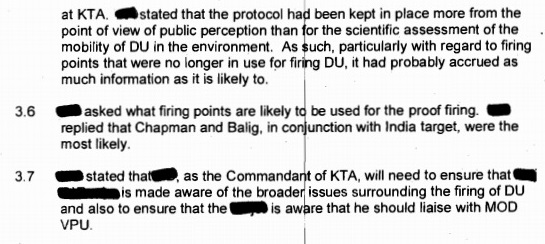
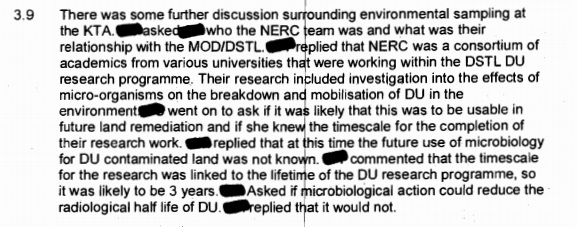
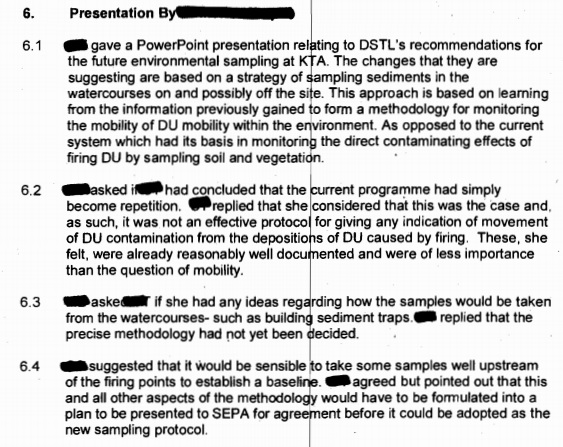
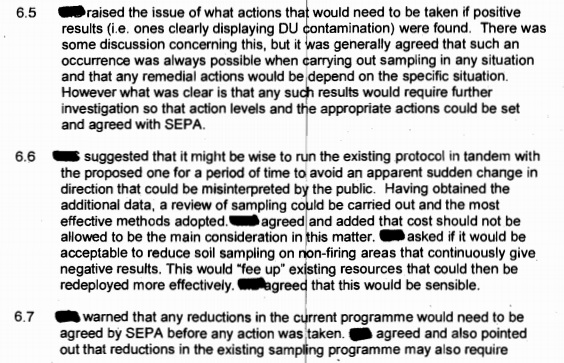
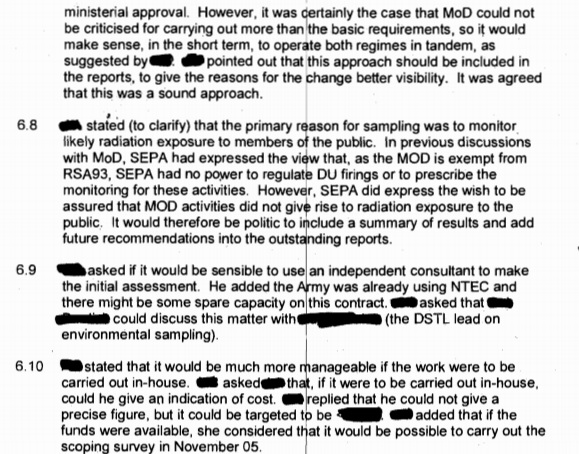
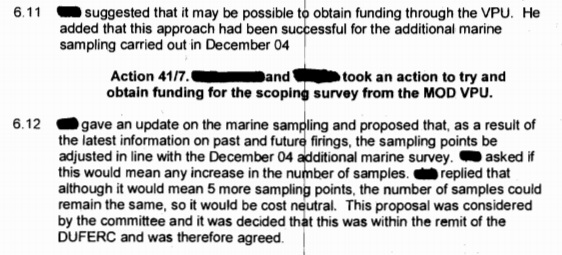
(Redacted name) gave the following summary of the findings relating to the life expectancy of DU metals in various environments: –
- Kirkcudbright soil 14 years
- Eskmeals soil 103 years
- Solway sea water 3 years
- Solway sediment 3 – 4 years
(Redacted name) asked if the oxide was mobile. (Redacted name) replied that the mobility would depend on the environment that the material was in and this this formed part of the CERN and British Geological Surveys research results, rather than the corrosion report. However, it had been observed that, in the Kirkcudbright environment, there were fissures in the rock and soil and material was carried into these, from where it could possibly be transferred further afield.
(Redacted name) reported that the BGS report on DU migration was with the IRB but he could say that they had completed a desktop study of the existing Kirkcudbright environmental reports and concluded that the evidence showed that the does attributable to DU at the firing point was (less than) mSV/year.
Full text here.
Excerpts from Minutes of the 42nd Meeting of the Depleted Uranium Firing Environmental Review Committee (DUFERC) on 8 February 2006
(Redacted name) gave a short presentation of the work he had carried out as a member of the DUWG. Of particular interest to the DUFERC was his knowledge of the DU Oversight Board and the results from the MoD’s DU in urine sampling programme. (Redacted name) asked (Redacted name) if the analysis was sensitive enough to be able to detect the presence of uranium after several years had elapsed since exposure. (Redacted name) confirmed that is the magnitude of the exposure was great enough to have an impact on health, the analysis could accurately detect uranium in urine, even twenty years after exposure.
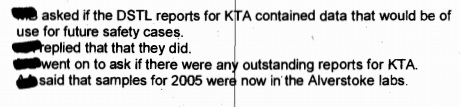
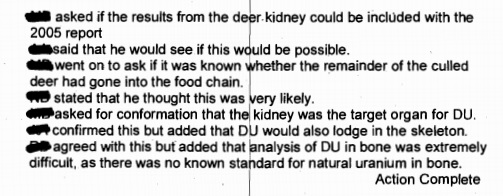
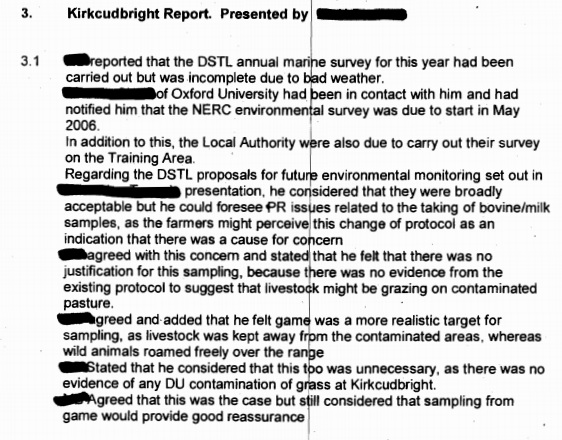
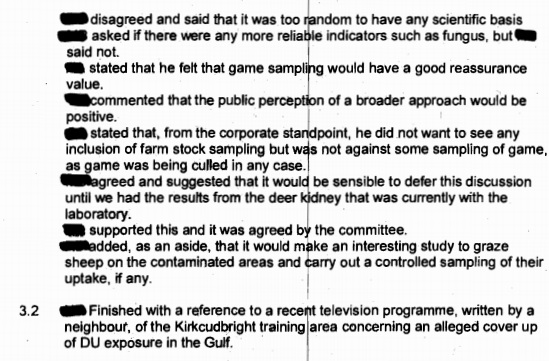
Full text here.